
10 Blockchain Uses That Have Nothing to Do With Crypto

Alex Rivera
February 3, 2026
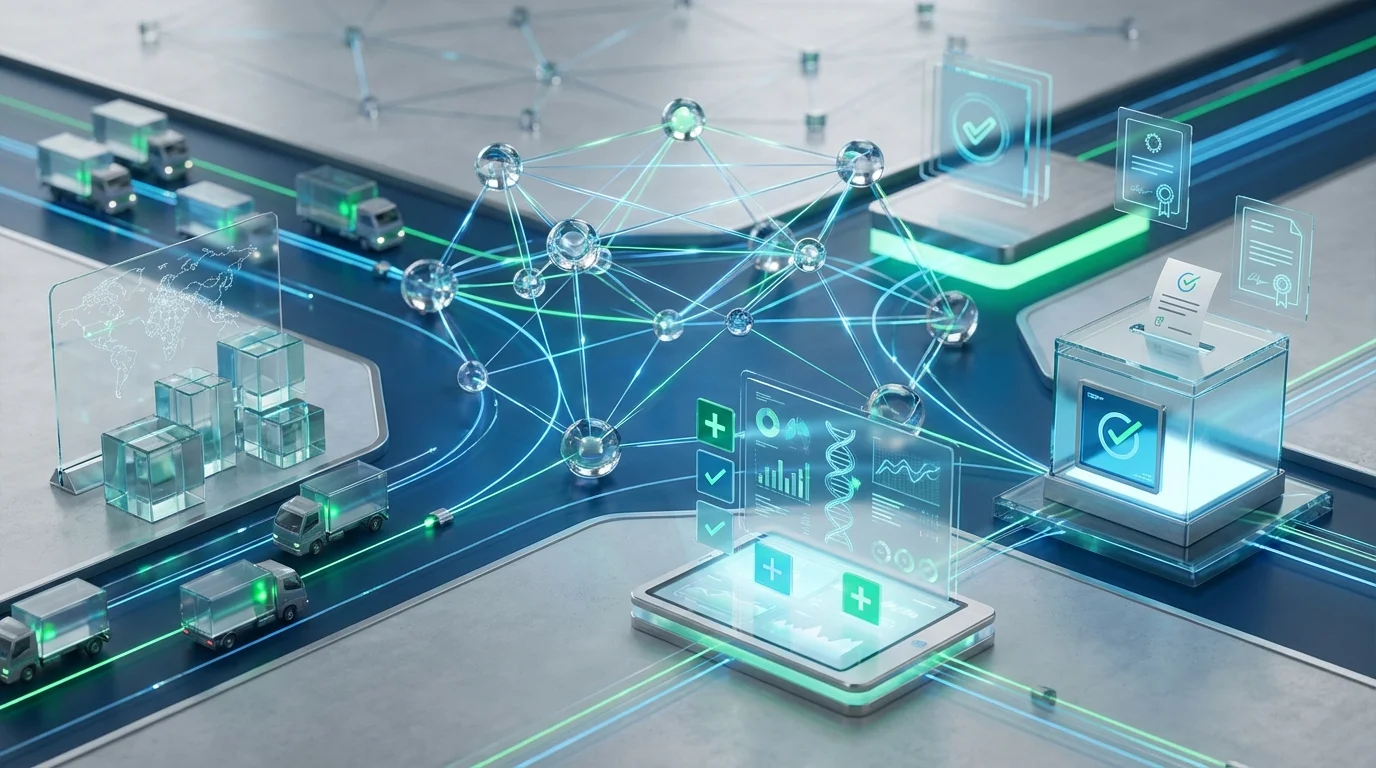
When most people hear "blockchain," they think of Bitcoin, cryptocurrency speculation, and volatile markets. That association has both helped and hurt the technology — helped by bringing massive investment and attention, hurt by linking a genuinely transformative technology to speculative excess.
Strip away the crypto hype, and blockchain is a remarkably useful technology for solving a specific class of problems: situations where multiple parties need to trust a shared record without trusting each other. This capability is quietly transforming industries far removed from cryptocurrency.
What Blockchain Actually Is (30-Second Explanation)
A blockchain is a digital ledger that is shared across a network, where records cannot be altered once added. Three properties make it useful:
Immutability: Once data is recorded, it cannot be changed or deleted. This creates a permanent, auditable trail.
Decentralization: No single entity controls the ledger. Multiple parties maintain copies, and consensus mechanisms ensure they all agree on the contents.
Transparency: Participants can verify records independently without relying on a central authority.
These properties are valuable whenever trust is the bottleneck — in supply chains where companies do not fully trust each other, in healthcare where patient records span multiple providers, in voting where election integrity is questioned.
Let us look at ten real-world applications that are already delivering value.
1. Supply Chain Transparency
The Problem
Global supply chains are opaque. When you buy a product, you trust that it is authentic, ethically sourced, and safe. But verifying these claims is difficult because supply chain data passes through dozens of organizations, each with their own systems and incentives.
Counterfeit goods cost the global economy over $500 billion annually. Food contamination outbreaks take days or weeks to trace to their source. Claims about ethical sourcing and sustainability are often impossible to verify.
The Blockchain Solution
Blockchain creates a shared, immutable record that every participant in the supply chain can contribute to and verify:
Walmart and food safety: Walmart uses IBM's Food Trust blockchain to track food from farm to shelf. When a contamination event occurs, tracing the source takes seconds instead of days. Before blockchain, identifying the source of contaminated romaine lettuce took almost a week. Now it takes 2.2 seconds.
De Beers and conflict diamonds: The diamond industry uses blockchain to track diamonds from mine to retail, ensuring they are not conflict diamonds. Each stone's journey is permanently recorded, creating a verifiable provenance.
Maersk and shipping: The world's largest shipping company uses blockchain to digitize shipping documentation. Previously, a single container shipment could require over 200 separate communications and interactions between 30 different parties. Blockchain reduces this to a shared, real-time record.
Impact
Supply chain blockchain is already mainstream in food, pharmaceuticals, luxury goods, and logistics. The value proposition is straightforward: reduced fraud, faster recalls, verifiable sustainability claims, and lower administrative costs.
2. Healthcare Records
The Problem
Your medical records are scattered across every doctor, hospital, lab, and pharmacy you have ever visited. Each maintains their own database, often in incompatible formats. When you visit a new doctor, your complete medical history is rarely available, leading to duplicated tests, missed drug interactions, and potentially dangerous gaps in care.
In the US alone, an estimated 80% of medical errors involve miscommunication during patient transfers.
The Blockchain Solution
Blockchain provides a patient-controlled, interoperable health record:
Patient ownership: You control who accesses your records. Grant temporary access to a new doctor, revoke it when treatment ends. No single hospital or insurer owns your data.
Interoperability: All providers record to the same blockchain, eliminating compatibility issues between different hospital systems.
Completeness: Every diagnosis, prescription, lab result, and procedure is recorded chronologically, creating a complete medical history that follows you across providers and even across countries.
Estonia's example: Estonia has implemented blockchain-based health records for its entire population. Every citizen has a complete, secure digital health record accessible by authorized providers. The system has reduced administrative costs, improved care coordination, and given patients genuine control over their health data.
Impact
Healthcare blockchain is in various stages of adoption globally. Regulatory requirements around health data (HIPAA in the US, GDPR in Europe) add complexity, but the benefits of interoperable, patient-controlled records are compelling enough to drive continued adoption.
3. Digital Identity
The Problem
Your digital identity is fragmented across hundreds of accounts, each requiring separate credentials. You rely on governments and corporations to verify who you are, and data breaches regularly expose your personal information. In developing countries, over a billion people lack any formal identification at all.
The Blockchain Solution
Self-sovereign identity (SSI) puts you in control of your digital identity:
Verifiable credentials: Instead of sharing your full personal details, you share cryptographic proofs. To prove you are over 21, you do not need to show your birthdate — you present a verified credential that confirms the fact without revealing additional information.
Portability: Your identity is not locked to any platform or government system. It works across services, borders, and institutions.
Privacy by design: You choose what to share, with whom, and for how long. No central database holds all your personal information.
Real-world deployment: The European Union's eIDAS 2.0 regulation mandates a digital identity wallet for all EU citizens by 2026. Blockchain-based verifiable credentials are a core technology enabling this initiative.
Impact
Digital identity on blockchain is advancing through government mandates (EU digital identity), corporate adoption (Microsoft's ION identity system), and humanitarian applications (UN refugee identification). This is one of the most consequential applications of blockchain technology.
4. Real Estate
The Problem
Buying property is slow, expensive, and paper-heavy. Title searches, escrow, notarization, and registration involve multiple intermediaries, each adding cost, time, and potential for error. Title fraud costs American homeowners $1 billion annually. In developing countries, unclear land records fuel disputes and prevent economic development.
The Blockchain Solution
Blockchain digitizes and secures property records:
Immutable ownership records: Once a property transaction is recorded on the blockchain, it cannot be altered. This eliminates title fraud and reduces the need for expensive title insurance.
Smart contract transactions: Property transfers can be automated through smart contracts that execute when all conditions are met — payment confirmed, inspections passed, documents signed. This reduces closing time from weeks to days.
Fractional ownership: Blockchain enables splitting property ownership into tokens, allowing multiple investors to own shares of a property. This lowers the barrier to real estate investment and increases market liquidity.
Sweden's land registry piloted blockchain-based property transactions, reducing processing time from months to hours and saving an estimated $100 million annually in reduced paperwork and fraud.
Impact
Real estate blockchain is moving from pilot projects to production systems in several countries. The combination of reducing fraud, lowering costs, and enabling new ownership models makes this a high-impact application.
5. Voting and Elections
The Problem
Election integrity concerns span the political spectrum. Paper ballots are slow to count and susceptible to human error. Electronic voting machines raise security and transparency concerns. Voter turnout in most democracies is disappointingly low, partly due to the inconvenience of physical polling places.
The Blockchain Solution
Blockchain-based voting offers a combination of security, transparency, and convenience:
Verifiability: Each voter can verify that their vote was recorded correctly without revealing how they voted. Anyone can audit the total count without accessing individual ballots.
Security: Votes recorded on a blockchain cannot be altered, deleted, or added after the fact. The distributed nature of blockchain means there is no single point of failure.
Accessibility: Blockchain voting can be conducted from any device, potentially increasing turnout by eliminating the need to visit a physical polling location.
Real-world use: Several municipalities and organizations have conducted blockchain-based elections. Utah County, Utah ran a blockchain pilot for municipal elections. The US state of West Virginia used blockchain voting for military personnel stationed overseas.
Challenges
Blockchain voting is technically promising but faces significant challenges: ensuring voter device security, preventing coercion in non-supervised environments, and building public trust in a new system. Most election security experts recommend cautious, gradual adoption with extensive auditing.
6. Intellectual Property and Royalties
The Problem
Creators — musicians, writers, artists, photographers — struggle to protect their work and receive fair compensation. Copyright infringement is rampant. Royalty distribution is opaque, with intermediaries taking large cuts. Proving ownership and licensing terms is cumbersome.
The Blockchain Solution
Blockchain creates permanent, verifiable records of creation and ownership:
Timestamped proof of creation: Recording creative work on a blockchain establishes irrefutable proof of when it was created and by whom. This simplifies copyright disputes enormously.
Automated royalty distribution: Smart contracts can automatically distribute royalties to all contributors whenever a work is used or purchased. A song could automatically pay the songwriter, performer, producer, and label according to predetermined splits — instantly, transparently, and without intermediaries.
Licensing automation: Content licensing terms can be encoded in smart contracts. When someone uses a licensed image, the payment and usage terms execute automatically.
Spotify's use: Spotify has explored blockchain for tracking song ownership and ensuring accurate royalty payments. The music industry's complex web of rights holders makes this a particularly valuable application.
Impact
Creative industry blockchain is gaining traction as artists and publishers recognize the value of automated, transparent rights management. The technology does not replace intermediaries entirely but dramatically reduces friction and improves transparency.
7. Insurance
The Problem
Insurance claims processing is slow, expensive, and frustrating. Verifying claims requires manual review, multiple data sources, and significant paperwork. Fraud costs the insurance industry tens of billions annually. Customers wait weeks or months for claim resolution.
The Blockchain Solution
Parametric insurance: Smart contracts that pay automatically when predefined conditions are met. A flight delay insurance policy could automatically pay when flight data confirms a delay exceeding the threshold. No claim filing, no processing, no waiting.
Fraud reduction: Shared blockchain records across insurers make it harder to file duplicate claims or misrepresent history. When your claims history is on an immutable ledger, previously reported incidents cannot be concealed.
Faster processing: Claims data shared on blockchain reduces verification time from weeks to minutes. When the hospital, the insurer, and the patient all share a common record, disputes about what happened and what is covered are resolved faster.
AXA's Fizzy: AXA launched Fizzy, a blockchain-based flight delay insurance product that automatically compensated passengers when their flight was delayed more than two hours. No claim filing required — the smart contract monitored flight data and paid automatically.
Impact
Insurance blockchain is moving from pilot to production, particularly for parametric products where automatic execution is straightforward. The longer-term impact on claims processing and fraud reduction will transform the industry.
8. Energy Trading
The Problem
The energy grid is evolving from centralized power plants to distributed generation — solar panels on homes, community wind farms, electric vehicle batteries feeding back to the grid. But the current energy market infrastructure was not designed for millions of small producers buying and selling electricity.
The Blockchain Solution
Peer-to-peer energy trading: Homeowners with solar panels can sell excess electricity directly to neighbors through blockchain-based markets. Smart meters record production and consumption, and smart contracts handle billing automatically.
Renewable energy certificates: Blockchain verifies and tracks green energy production, ensuring that renewable energy credits are not double-counted or fraudulently created.
Grid management: In a distributed energy system, blockchain provides the coordination layer for millions of small transactions between producers and consumers.
Brooklyn Microgrid: A pioneering project in Brooklyn, New York, allows residents with solar panels to sell surplus energy directly to neighbors via blockchain, bypassing traditional utility intermediaries.
Impact
Energy blockchain aligns perfectly with the transition to distributed renewable energy. As more homes and businesses generate their own power, blockchain provides the trusted coordination layer that makes peer-to-peer energy markets practical.
9. Education and Credentials
The Problem
Verifying educational credentials is surprisingly difficult. Employers cannot easily confirm degrees, certifications, and training. Diploma fraud is a growing problem. And when workers move between countries, credential recognition becomes even more complex.
The Blockchain Solution
Verifiable credentials: Universities and training providers issue digital credentials on blockchain. These can be verified instantly by anyone, anywhere, without contacting the issuing institution.
Lifelong learning records: A comprehensive, portable record of all education and training — formal degrees, professional certifications, online courses, workplace training — in a single verifiable profile.
Micro-credentials: Blockchain enables recognition of specific skills and competencies, not just complete degrees. This supports the shift toward skills-based hiring and continuous professional development.
MIT's digital diplomas: MIT issues blockchain-verified digital diplomas that graduates can share with employers for instant verification. No phone calls to the registrar, no waiting for transcripts.
Impact
Educational credential blockchain is being adopted by universities, professional certification bodies, and governments. The EU's Europass initiative includes blockchain-verified credentials as a core component.
10. Charitable Giving and Aid Distribution
The Problem
Donors often cannot verify how their contributions are used. Aid distribution in crisis zones is plagued by corruption, diversion, and inefficiency. Tracking funds through multiple intermediaries is nearly impossible.
The Blockchain Solution
Transparent fund tracking: Donations recorded on blockchain can be tracked from donor to final beneficiary, creating complete transparency about how funds are used.
Direct aid distribution: Blockchain-based systems can deliver aid directly to beneficiaries via digital wallets, bypassing intermediaries that might divert funds.
Conditional giving: Smart contracts can release funds only when specific conditions are verified — a school built, a well completed, medical supplies delivered.
UN World Food Programme: The WFP's Building Blocks program uses blockchain to distribute cash assistance to refugees. Over 1 million refugees have received aid through the program, with reduced transaction costs and improved transparency.
Impact
Humanitarian blockchain is already operating at scale. The combination of transparency, reduced costs, and direct delivery makes it one of the most impactful applications of blockchain technology.
Frequently Asked Questions
Does blockchain require cryptocurrency? No. Many enterprise blockchain applications use no cryptocurrency at all. The blockchain provides the shared, immutable ledger — cryptocurrency is just one possible application of that technology.
Is blockchain environmentally harmful? Bitcoin's proof-of-work consensus mechanism is energy-intensive. But most enterprise and modern blockchains use proof-of-stake or other efficient consensus mechanisms that consume a tiny fraction of Bitcoin's energy. The environmental concern is specific to certain cryptocurrencies, not blockchain technology broadly.
Why hasn't blockchain been adopted more widely? Adoption is growing steadily but faces hurdles: integration with existing systems, regulatory uncertainty, the need for industry-wide cooperation, and the legacy of cryptocurrency hype creating skepticism. Most industries are in the early-to-mid adoption phase.
Can blockchain be hacked? The blockchain itself is extremely secure — altering records would require controlling a majority of the network, which is practically impossible on well-designed systems. Vulnerabilities tend to exist in the applications built on top of blockchain (wallets, smart contracts) rather than the blockchain itself.
The Bottom Line
Blockchain's most transformative applications have nothing to do with cryptocurrency speculation. Supply chain transparency, healthcare records, digital identity, real estate, voting, creative rights, insurance, energy trading, education credentials, and humanitarian aid are all being meaningfully improved by blockchain technology.
The common thread is trust. Wherever multiple parties need to share reliable data without a trusted intermediary, blockchain provides a solution. As these applications mature and scale, blockchain will become an invisible but essential part of the infrastructure that makes modern systems work — much like the internet protocols that power our online world today.