
Digital Twins: The $48B Tech Most People Ignore

Alex Rivera
February 13, 2026
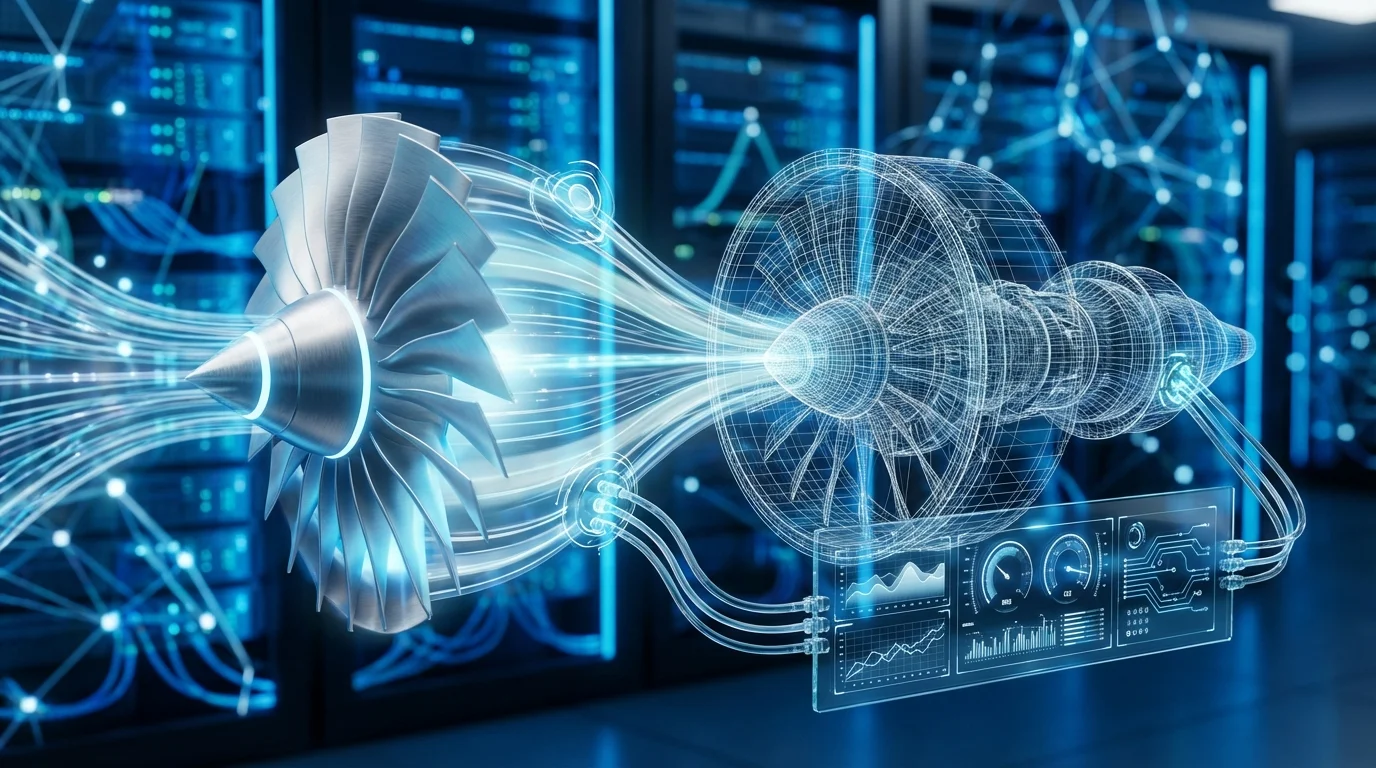
Somewhere in a data center, there is a virtual copy of a jet engine that exists on a Rolls-Royce aircraft flying right now over the Atlantic Ocean. This digital replica receives real-time data from hundreds of sensors on the physical engine — temperature, pressure, vibration, fuel flow, rotational speed. It simulates the engine's behavior moment by moment, comparing what is happening to what should be happening. When the simulation detects an anomaly — a bearing that is vibrating slightly more than expected, a temperature gradient that suggests early wear — it alerts engineers before any problem becomes visible in the physical world.
This is a digital twin. Not a static 3D model or a simple dashboard of sensor readings, but a dynamic, continuously updated virtual replica that mirrors the state and behavior of a physical system in real-time. It is one of the most practically transformative technologies of the past decade, and by 2026, it has moved from advanced engineering to mainstream industrial practice.
This article explains what digital twins are, how they work, where they are delivering real value, and why they represent a fundamental shift in how we design, operate, and maintain physical systems.
What Is a Digital Twin?
Definition
A digital twin is a virtual representation of a physical object, process, or system that is connected to its real-world counterpart through data. The connection is bidirectional and continuous: sensors on the physical system feed data to the digital twin, and insights from the digital twin inform decisions about the physical system.
Three elements distinguish a digital twin from a simple simulation or 3D model:
Real-time data connection: The twin receives continuous data from its physical counterpart, keeping the virtual and physical versions synchronized.
Physics-based modeling: The twin does not just display data — it uses mathematical models of physics, materials science, thermodynamics, and other disciplines to simulate how the physical system behaves and predict how it will behave in the future.
Bidirectional interaction: Insights from the twin feed back to the physical system, informing maintenance decisions, operational adjustments, and design improvements.
A Brief History
The concept of digital twins originated at NASA. In the early days of space exploration, NASA engineers built physical replicas of spacecraft on the ground that mirrored the conditions of the craft in space. When Apollo 13 suffered an explosion en route to the Moon, engineers used ground-based simulators to test solutions before transmitting instructions to the crew.
The term "digital twin" was coined by Michael Grieves at the University of Michigan in 2002, in the context of product lifecycle management. The idea was simple: maintain a digital counterpart of a physical product throughout its entire life, from design through manufacturing, operation, and decommissioning.
But the concept remained largely theoretical until the 2010s, when three technologies matured enough to make digital twins practical: cheap, ubiquitous sensors (IoT), cloud computing with sufficient power to run complex simulations, and machine learning algorithms capable of learning system behavior from data.
Types of Digital Twins
Digital twins exist at different scales and levels of complexity:
Component twins: Model individual parts — a turbine blade, a bearing, a circuit board. These are the simplest twins and focus on predicting the wear, fatigue, or failure of specific components.
Asset twins: Model complete machines or systems — an entire engine, a wind turbine, a production robot. Asset twins integrate data from multiple component twins and model how components interact.
System twins: Model collections of assets working together — a production line, a power plant, a fleet of vehicles. System twins capture the interactions and dependencies between assets.
Process twins: Model entire business processes or operations — a supply chain, a logistics network, a city's transportation system. These are the most complex twins and often integrate data from multiple system twins.
How Digital Twins Work
The Data Foundation
Every digital twin starts with data. Sensors on the physical system measure everything relevant: temperature, pressure, vibration, flow rates, electrical signals, position, speed, humidity, chemical composition. Modern IoT sensors are small, cheap, wireless, and energy-efficient enough to instrument virtually any physical system.
The volume of data can be enormous. A single modern jet engine has over 5,000 sensors generating data continuously. A large manufacturing facility may have hundreds of thousands of sensor data points. A smart building monitors thousands of environmental and occupancy variables.
This data is transmitted to the digital twin platform through various channels: direct wired connections for high-bandwidth industrial sensors, wireless IoT protocols for distributed sensors, edge computing for time-sensitive processing, and cloud infrastructure for storage and heavy computation.
The Model Layer
Raw sensor data alone is not a digital twin. The data must be integrated with models that understand what the data means and can predict what will happen next.
Digital twins typically combine multiple types of models:
Physics-based models: Mathematical representations of physical laws — fluid dynamics, thermodynamics, structural mechanics, electrical behavior. These models encode our fundamental understanding of how physical systems work. A physics model of a building, for example, calculates heat transfer, air flow, and structural loads based on first principles.
Data-driven models: Machine learning models trained on historical data to recognize patterns and predict outcomes. A data-driven model might learn that a specific pattern of vibration data precedes a bearing failure, even if the physics are too complex to model analytically.
Hybrid models: The most effective digital twins combine both approaches. Physics models provide a foundation of understanding, while machine learning fills in the gaps where physics is too complex or where empirical patterns are more reliable than theoretical predictions.
The Simulation Engine
The simulation engine runs the models continuously, using real-time sensor data as inputs and generating predictions, anomaly alerts, and optimization recommendations as outputs.
Advanced simulation engines can run scenarios: "What would happen if we increased the operating temperature by 5 degrees?" "How would the system respond to a sudden demand spike?" "If we delay maintenance by two weeks, what is the risk of failure?" This scenario capability transforms digital twins from monitoring tools into decision-support systems.
The Visualization Layer
Digital twins are often visualized as 3D models that engineers and operators can interact with — rotating, zooming, clicking on components to see their status and predicted future. But visualization is just the interface, not the twin itself. The real value lies in the models and predictions underneath.
Modern digital twin platforms offer multiple visualization modes: 3D spatial views for physical understanding, dashboard views for monitoring key metrics, timeline views for tracking trends, and alert views for highlighting issues that need attention.
Digital Twins in Manufacturing
Predictive Maintenance
The single most common and highest-value application of digital twins in manufacturing is predictive maintenance. Traditional maintenance is either reactive (fix it when it breaks) or preventive (maintain it on a fixed schedule regardless of condition). Both approaches are wasteful: reactive maintenance causes expensive unplanned downtime, while preventive maintenance often replaces components that still have useful life remaining.
Digital twin-based predictive maintenance monitors the actual condition of equipment in real-time, predicts when failure is likely to occur, and recommends maintenance at the optimal time — late enough to maximize component life, early enough to prevent unplanned failure.
The economic impact is substantial. Industries that have adopted predictive maintenance through digital twins report 25-35% reductions in maintenance costs, 70-75% reductions in equipment failures, and 10-20% increases in equipment lifespan. For industries where unplanned downtime costs millions of dollars per hour — oil and gas, semiconductor manufacturing, large-scale production — the return on investment is compelling.
Production Optimization
Digital twins of entire production lines allow manufacturers to optimize operations in ways that would be impossible without simulation.
Consider a steel mill. Hundreds of variables — temperature profiles, rolling speeds, cooling rates, chemical compositions — interact in complex ways to determine the quality and properties of the finished steel. Adjusting one variable affects all the others. A digital twin models these interactions and identifies the optimal combination of settings for each product specification.
Siemens, one of the leading digital twin platform providers, reports that customers using production digital twins achieve 10-15% improvements in throughput and 20-30% reductions in quality defects. These improvements come not from any single optimization but from the continuous refinement that a digital twin enables.
New Product Development
Digital twins are also transforming how products are designed and tested. Instead of building and testing physical prototypes — an expensive and time-consuming process — engineers design, simulate, and refine products in the digital twin environment before any physical manufacturing begins.
Automotive companies like BMW and Tesla use digital twins extensively in vehicle development. Crash simulations, aerodynamic testing, thermal management, and electrical system validation all happen in the digital twin before the first physical prototype is built. This approach reduces development time by months, reduces prototyping costs by millions of dollars, and enables exploration of design alternatives that would be impractical to build physically.
Digital Twins for Cities and Infrastructure
Smart City Twins
Several cities worldwide have created digital twins of their entire urban environment. Singapore's Virtual Singapore project was one of the first comprehensive city-scale digital twins. It models the city's buildings, infrastructure, terrain, and demographics, enabling urban planners to simulate the effects of new developments, transportation changes, and environmental policies before implementation.
Other cities have followed. Helsinki, Shanghai, Zurich, and several others now maintain city-scale digital twins. These twins integrate data from traffic sensors, weather stations, energy meters, building management systems, and public transit to create a real-time understanding of how the city operates.
Applications include traffic optimization (simulating the effects of signal timing changes, new routes, or road closures), energy management (modeling solar exposure, wind patterns, and heating demand across the city), flood prediction (simulating water flow based on rainfall forecasts and terrain), and urban planning (visualizing proposed developments in context and simulating their impact on traffic, shadows, wind, and pedestrian flow).
Infrastructure Management
Bridges, tunnels, dams, pipelines, and other critical infrastructure are increasingly monitored through digital twins. Sensors embedded during construction or installed afterward track structural health, environmental conditions, and usage patterns.
The I-35W bridge collapse in Minneapolis in 2007, which killed 13 people, was caused by a design flaw that worsened over decades of use. A digital twin monitoring the bridge's structural behavior in real-time could potentially have detected the progressive deterioration and triggered an alert before catastrophic failure.
In 2026, digital twins are standard practice for major new infrastructure projects and are being retrofitted to existing critical structures. The investment is driven both by safety considerations and by the economic benefits of optimized maintenance — replacing parts based on actual condition rather than conservative schedules.
Digital Twins in Healthcare
Patient Digital Twins
One of the most ambitious applications of digital twin technology is the patient digital twin — a computational model of an individual patient's physiology that can simulate how they will respond to treatments, medications, and lifestyle changes.
The concept is still in early stages, but several research projects and startups are making progress. Dassault Systemes' Living Heart Project created detailed digital twins of the human heart, used to simulate cardiac procedures and test medical devices virtually. The project has expanded to model other organs and systems.
A patient digital twin would integrate genetic data, medical history, imaging data, wearable sensor data, and laboratory results into a comprehensive model. Doctors could simulate different treatment options on the twin before choosing the best approach for the real patient. "What if we prescribe Drug A versus Drug B? What dosage would be optimal for this patient's metabolism? How would this surgical approach compare to a less invasive alternative?"
Hospital Operations
At a less futuristic but immediately practical level, hospitals are using digital twins to optimize operations. A hospital digital twin models patient flow, staff allocation, equipment utilization, and resource availability.
By simulating different scenarios — "What happens during a surge of emergency admissions?" "How should we redistribute staff if this operating room goes down for maintenance?" — hospital administrators can make better operational decisions. During the COVID-19 pandemic, several hospitals used digital twins to plan ICU capacity, ventilator allocation, and staffing under various scenario projections.
Drug Development
Pharmaceutical companies use digital twins of biological systems — organs, disease pathways, molecular interactions — to accelerate drug development. Virtual patient populations can be simulated to predict drug efficacy and side effects before clinical trials, potentially reducing the number of failed trials and accelerating the path to market.
The FDA has begun accepting computational evidence from digital twin simulations as supplementary data in drug and medical device approval processes, signaling institutional recognition of the technology's validity.
Digital Twins in Aerospace and Defense
Aircraft Engine Monitoring
General Electric and Rolls-Royce were pioneers in applying digital twin technology to jet engines, and the application remains one of the most mature and well-documented.
Every modern jet engine sold by these manufacturers comes with a digital twin that monitors its performance throughout its operational life. The twin receives data from hundreds of on-engine sensors, runs physics-based simulations to compare actual performance to expected performance, and predicts maintenance needs.
This capability has transformed the business model of jet engine manufacturing. Both GE and Rolls-Royce now sell "power by the hour" — airlines pay for engine performance rather than purchasing engines outright. The digital twin is what makes this model work: by predicting maintenance needs and optimizing engine operation, the manufacturers can guarantee performance levels and manage maintenance costs.
Satellite and Space Systems
Space agencies and satellite operators use digital twins to monitor and manage systems that are physically inaccessible after launch. A satellite's digital twin tracks its orbital position, power system state, thermal conditions, communication performance, and remaining fuel. Operators can simulate maneuvers and configuration changes on the twin before commanding the actual satellite.
NASA's Artemis program uses digital twins extensively for mission planning, crew training, and real-time mission management. The approach traces directly back to NASA's Apollo-era practice of maintaining ground replicas, now updated with modern simulation and data integration capabilities.
Nvidia Omniverse and Simulation Platforms
The Platform Landscape
Building a digital twin requires sophisticated software platforms. Several companies offer comprehensive digital twin platforms:
Nvidia Omniverse: Originally a 3D collaboration platform, Omniverse has evolved into a powerful digital twin simulation environment. Its key advantage is GPU-accelerated physics simulation, which enables real-time rendering and simulation of complex systems with visual fidelity that approaches photorealism. Nvidia's partnerships with industrial companies like BMW, Siemens, and Ericsson have produced impressive demonstrations of factory-scale digital twins.
Siemens Xcelerator: Siemens offers one of the most comprehensive industrial digital twin platforms, spanning product design (NX), manufacturing simulation (Tecnomatix), and operational monitoring (MindSphere). Their platform is particularly strong in discrete manufacturing.
Microsoft Azure Digital Twins: Part of the Azure cloud platform, this service provides the infrastructure for creating and managing digital twins at scale. Its integration with the broader Azure ecosystem — IoT Hub, AI services, Power BI — makes it a natural choice for organizations already invested in Microsoft's cloud.
PTC ThingWorx: Focused on industrial IoT and digital twins, ThingWorx integrates with PTC's CAD and PLM software to create digital twins that span the product lifecycle from design through operation.
ANSYS Twin Builder: Specializes in physics-based simulation, creating digital twins that model the physical behavior of systems with high fidelity. Particularly strong for applications where accurate physics modeling is critical.
Open Source and Standards
The digital twin ecosystem is increasingly supported by open standards and open-source tools. The Digital Twin Consortium, founded in 2020, is developing common frameworks and best practices. The Eclipse Digital Twin initiative provides open-source components for building digital twin systems.
Standardization is important because digital twins often need to integrate data and models from multiple vendors. An aircraft digital twin might combine engine data from GE, structural data from Boeing, and environmental data from weather services. Without common standards, this integration is expensive and fragile.
ROI and Business Case
Quantifying the Value
The business case for digital twins varies by application, but several categories of value are consistent:
Reduced downtime: For industries where unplanned downtime is expensive — manufacturing, oil and gas, airlines, data centers — digital twin-based predictive maintenance typically delivers the fastest and largest return on investment. Reductions of 30-50% in unplanned downtime are commonly reported.
Extended asset life: By maintaining equipment based on actual condition rather than conservative schedules, digital twins extend the useful life of expensive assets by 10-25%. For assets like jet engines, wind turbines, or industrial robots, this represents significant capital savings.
Improved quality: Digital twin-optimized production processes consistently produce fewer defects. In semiconductor manufacturing, where defect rates directly impact yield and profitability, digital twins have become essential.
Faster development: Using digital twins for design and testing reduces physical prototyping requirements and accelerates time to market. Automotive companies report development cycle reductions of 20-30%.
Energy efficiency: Digital twins that optimize building systems, industrial processes, or logistics can reduce energy consumption by 10-20%, with corresponding cost savings and environmental benefits.
Implementation Costs
Digital twin implementations range from relatively modest (instrumenting a single machine with sensors and connecting it to a cloud-based twin) to very large (creating a comprehensive twin of an entire factory, city, or product line). Costs include sensor hardware, data infrastructure, platform licensing, model development, and integration.
For most organizations, the recommended approach is to start with a focused pilot — a single high-value asset or process — demonstrate ROI, and then expand. The technology platforms and implementation methodologies have matured enough that the primary barrier is no longer technical feasibility but organizational readiness and change management.
Challenges and Limitations
Data Quality and Integration
Digital twins are only as good as the data that feeds them. Sensor failures, data gaps, calibration drift, and integration challenges between different data sources can all degrade twin accuracy. Maintaining data quality across thousands of sensors over years of operation is an ongoing challenge.
Model Accuracy
Physics-based models are approximations of reality. They capture the most important dynamics but inevitably simplify complex systems. Machine learning models can capture patterns that physics models miss, but they are only as good as the data they are trained on and may fail when conditions exceed the range of their training data.
The most robust digital twins combine physics and machine learning models and include uncertainty quantification — they do not just predict what will happen but estimate how confident the prediction is.
Scalability
Creating a digital twin for a single asset is well understood. Creating twins for thousands of assets across a global operation, keeping them all synchronized and accurate, and managing the resulting data volumes is a significantly harder problem. Platform vendors are improving scalability, but large-scale digital twin deployments remain complex undertakings.
Cybersecurity
Digital twins create a detailed virtual replica of physical systems, including their vulnerabilities. A compromised digital twin could reveal how to disrupt the physical system it models. Securing digital twins requires the same rigor applied to any critical industrial control system, with the added complexity that twins often span multiple networks and organizations.
Conclusion
Digital twins represent a fundamental shift in how we interact with the physical world. By creating living virtual replicas of physical systems, we gain the ability to monitor, predict, optimize, and simulate in ways that were previously impossible.
The technology has already proven its value in aerospace, manufacturing, energy, and infrastructure. Healthcare, urban planning, and other sectors are following as platforms mature and costs decrease. The convergence of IoT, cloud computing, AI, and simulation technology has made digital twins practical and accessible.
For organizations managing complex physical assets or processes, the question is no longer whether to adopt digital twin technology but where to start and how to scale. The competitive advantage of better prediction, faster optimization, and smarter decision-making is too significant to ignore.
The physical world is becoming programmable, and digital twins are the interface.