
The $500B Space Economy Nobody Talks About

Alex Rivera
February 13, 2026
In 1969, launching a kilogram of payload into low Earth orbit cost approximately $100,000 in today's dollars. By 2010, that cost had dropped to roughly $20,000. In 2026, SpaceX's Falcon 9 delivers cargo to orbit for under $3,000 per kilogram, and the fully reusable Starship aims to push that figure below $100.
That cost reduction — roughly 1,000x over half a century — has transformed space from an exclusive domain of superpowers and their space agencies into a rapidly growing commercial industry. Thousands of companies now operate in space or build technology for space applications. Venture capital investment in space startups has exceeded $10 billion annually. The global space economy, including satellite services, ground equipment, manufacturing, and launch, is valued at over $500 billion.
Space technology in 2026 is not science fiction. It is infrastructure, commerce, and an increasingly important part of everyday life — even if most people do not realize it. This article explores the technologies, companies, and trends shaping the new space economy.
Satellite Internet: Connecting the Unconnected
The Starlink Story
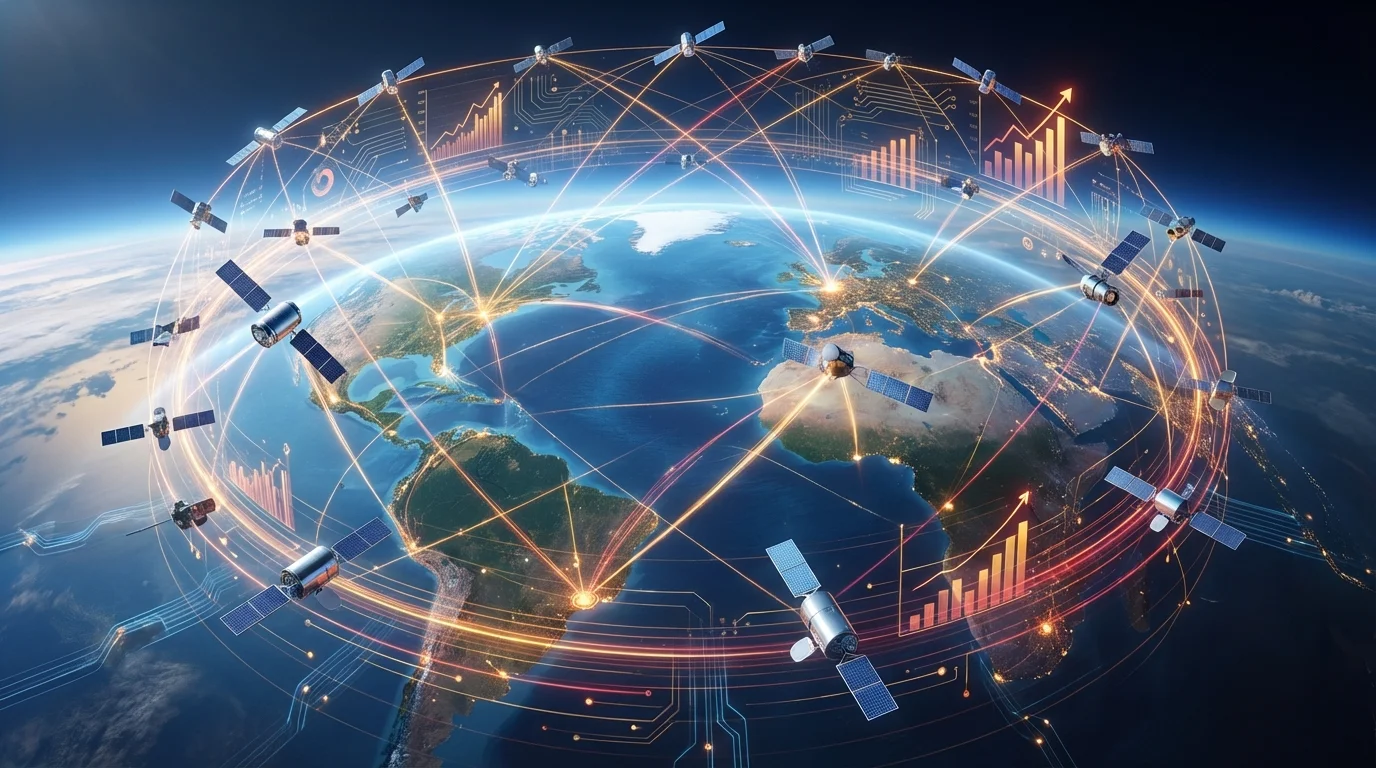
SpaceX's Starlink is the most visible and commercially successful satellite internet constellation in history. As of early 2026, Starlink operates over 6,000 satellites in low Earth orbit, providing broadband internet service to approximately 4 million subscribers across more than 70 countries.
The technical achievement is remarkable. Traditional geostationary communication satellites orbit at 35,786 kilometers, resulting in latency of 500-600 milliseconds — noticeable and problematic for video calls, gaming, and real-time applications. Starlink satellites orbit at roughly 550 kilometers, reducing latency to 20-40 milliseconds — comparable to many terrestrial broadband connections.
But Starlink's impact extends far beyond technical specifications. For the first time, high-speed internet is available virtually anywhere on Earth's surface. Rural communities that cable and fiber companies declined to serve now have broadband. Ships at sea, aircraft in flight, and research stations in Antarctica have reliable connectivity. During natural disasters, Starlink terminals have provided emergency communications when terrestrial infrastructure was destroyed.
The military implications are equally significant. Ukraine's use of Starlink during its conflict with Russia demonstrated the strategic value of satellite internet that cannot be disrupted by ground-based infrastructure attacks. This has accelerated military interest in satellite communications worldwide.
Competitors Enter the Market
Starlink was first, but it is no longer alone. Several competitors are deploying their own constellations:
Amazon Kuiper: Amazon's Project Kuiper has begun deploying its constellation of over 3,200 satellites. With Amazon's deep financial resources, integration with AWS cloud services, and existing customer base, Kuiper is positioned as Starlink's most formidable competitor. The first commercial services launched in 2025.
OneWeb (Eutelsat): Merged with Eutelsat in 2023, OneWeb operates a constellation focused primarily on enterprise and government customers rather than consumer broadband. Its medium Earth orbit constellation (approximately 1,200 kilometers) offers a different set of trade-offs than Starlink's lower orbit.
Telesat Lightspeed: Canadian company Telesat is deploying a smaller, enterprise-focused constellation optimized for high-throughput connectivity for telecom operators, airlines, and government customers.
China's mega-constellations: China has announced plans for multiple large satellite constellations totaling over 25,000 satellites, including the Guowang constellation and the G60 Starlink competitor. These are motivated by both commercial ambition and strategic desire to reduce dependence on Western satellite systems.
The Digital Divide
Satellite internet's most profound impact may be on the global digital divide. Approximately 2.6 billion people worldwide still lack internet access, primarily in rural and developing areas where terrestrial infrastructure is economically unviable. Satellite internet can reach these populations without the massive ground infrastructure investment that fiber or cellular networks require.
The challenge is affordability. Starlink's current pricing — roughly $120 per month plus a $499 terminal — is accessible in developed countries but prohibitively expensive for most of the world's unconnected population. Subsidized programs, lower-cost terminals, and community-shared connections are emerging to address this gap, but making satellite internet affordable for the world's poorest communities remains an unsolved challenge.
Earth Observation: Seeing the Planet in Detail
The Satellite Imagery Revolution
Earth observation satellites have undergone a transformation as dramatic as communications satellites. Traditionally dominated by government agencies operating a handful of expensive satellites, the sector now includes dozens of commercial companies operating hundreds of satellites that image the entire Earth's surface daily.
Planet Labs: Operates the largest constellation of Earth-imaging satellites — over 200 spacecraft that photograph every point on Earth's land surface every day at 3-meter resolution. This daily global coverage enables applications from crop monitoring to deforestation tracking to urban change detection.
Maxar Technologies: Provides the highest-resolution commercial satellite imagery available — down to 30 centimeters, enough to identify individual vehicles, count shipping containers, and assess building damage.
Capella Space and ICEYE: Operate synthetic aperture radar (SAR) satellites that can image through clouds and at night — overcoming the two main limitations of optical satellites. SAR imagery is particularly valuable for disaster response, maritime monitoring, and defense applications.
Applications Across Industries
The value of satellite imagery lies not in the pictures themselves but in the intelligence extracted from them:
Agriculture: Farmers and agricultural companies use satellite data to monitor crop health, predict yields, detect irrigation problems, and optimize fertilizer application. Precision agriculture based on satellite data has become standard practice for large-scale farming operations.
Climate and environment: Scientists track deforestation, glacier retreat, coral reef health, wildfires, and urban heat islands using satellite data. Organizations like Global Forest Watch use Planet Labs imagery to detect deforestation within days, enabling rapid response by enforcement agencies.
Finance: Hedge funds and investment firms analyze satellite data to gain trading insights. Counting cars in retail parking lots, measuring oil storage tank fill levels, tracking shipping container movements, and monitoring agricultural output — all visible from space — provide leading indicators of economic activity.
Insurance: Insurers use satellite imagery to assess damage after natural disasters, verify claims, and model risk. After a hurricane, satellite imagery can assess damage across an entire affected area within hours, accelerating claims processing and resource allocation.
Urban planning: City planners use satellite data to monitor urban sprawl, track construction activity, assess infrastructure condition, and model population density changes over time.
AI and Satellite Data
The explosion in satellite imagery volume has created a data processing challenge that only AI can solve. A single satellite generates terabytes of imagery per day. Hundreds of satellites generate more imagery than any human team could analyze.
AI models trained to interpret satellite imagery can automatically detect changes, classify land use, count objects, measure vegetation health, and identify anomalies at a scale and speed impossible for human analysts. Companies like Orbital Insight, Descartes Labs, and SpaceKnow specialize in applying AI to satellite data, turning raw imagery into actionable intelligence.
Space Manufacturing and In-Space Economy
Why Manufacture in Space?
Space offers unique manufacturing conditions that cannot be replicated on Earth:
Microgravity: Without gravity, materials behave differently. Crystals grow larger and more perfectly. Alloys mix more uniformly. Fiber optic cables can be drawn with fewer defects. Biological cells grow in three dimensions rather than flat layers. These differences enable products with properties that are impossible or extremely difficult to achieve on Earth.
Vacuum: Space provides an almost perfect vacuum for free — something that is expensive to create and maintain in terrestrial facilities. This is valuable for certain semiconductor manufacturing, thin-film deposition, and materials processing.
Temperature extremes: The contrast between sunlit and shadowed areas in space provides access to extreme temperatures for specialized manufacturing processes.
Current Progress
Space manufacturing is in its earliest commercial stages, but several companies are pursuing it seriously:
Varda Space Industries: Has successfully manufactured pharmaceutical crystals in orbit and returned them to Earth. Their approach uses small, uncrewed capsules that launch on commercial rockets, manufacture products in microgravity for days to weeks, and then re-enter the atmosphere for recovery. The initial focus is on pharmaceutical compounds that crystallize more effectively in microgravity, producing drugs with higher bioavailability.
Space Forge: A Welsh startup developing reusable satellites designed for in-space manufacturing of advanced semiconductors and alloys. Their approach targets materials where the microgravity advantage is large enough to justify the cost of space access.
Redwire Space: Provides manufacturing capabilities on the International Space Station, including 3D printing and materials processing. Their Made In Space subsidiary has demonstrated various manufacturing techniques in orbit.
The economics of space manufacturing depend on the value-to-mass ratio of the product. Pharmaceuticals, specialty semiconductors, and unique materials can justify the cost of launch and recovery because the end products are extremely valuable per kilogram. Bulk materials cannot. As launch costs continue to decline, the range of economically viable space manufacturing expands.
Asteroid Mining: The Long-Term Prize
The Resource Opportunity
Asteroids contain vast quantities of metals and minerals. A single metallic asteroid one kilometer in diameter could contain more platinum-group metals than have ever been mined on Earth. Water ice on asteroids could be converted to rocket fuel in space, dramatically reducing the cost of deep-space missions.
The near-Earth asteroid population includes thousands of objects that are potentially accessible with current or near-future technology. Some pass closer to Earth than the Moon, making them energetically easier to reach than the lunar surface.
Where We Stand
Asteroid mining remains in the pre-commercial phase. The technical challenges are immense: reaching an asteroid, anchoring to it in microgravity, extracting resources, processing them, and returning the products to where they are needed. Several ambitious startups (Planetary Resources, Deep Space Industries) attempted to tackle these challenges in the 2010s but ran out of funding before achieving commercial operations.
The concept has not been abandoned. NASA's OSIRIS-REx mission successfully collected and returned samples from asteroid Bennu in 2023, demonstrating that asteroid material can be collected and returned to Earth. Japan's Hayabusa2 mission accomplished a similar feat with asteroid Ryugu.
Current thinking has shifted from returning mined materials to Earth (where they would compete with terrestrial mining) to using space resources in space. Water for rocket fuel, metals for in-space construction, and regolith for radiation shielding would be consumed in space, where their value is enormously higher than on Earth because of the cost of launching materials from Earth's surface.
Space Tourism: An Emerging Industry
The Current Landscape
Space tourism has transitioned from a billionaire novelty to a small but growing industry:
SpaceX: Has conducted orbital tourism missions, including the Inspiration4 all-civilian mission in 2021 and subsequent missions carrying paying customers. SpaceX's Starship, when fully operational, aims to make orbital tourism significantly more affordable and routine.
Blue Origin: Jeff Bezos's company operates the New Shepard vehicle for suborbital tourism flights, carrying passengers to the edge of space for a few minutes of weightlessness and a view of Earth from above. Flights have become somewhat routine, with dozens of passengers having flown.
Virgin Galactic: Richard Branson's company offers suborbital spaceplane flights from its Spaceport America facility in New Mexico. After years of delays, commercial service has begun, though at a pace slower than initially projected.
Axiom Space: Conducts private missions to the International Space Station, hosting paying customers for multi-day stays in orbit. Axiom is also building the first commercial space station, planned to initially attach to the ISS and eventually operate independently.
The Pricing Curve
Space tourism pricing currently ranges from roughly $450,000 for a suborbital flight (Virgin Galactic) to $55 million or more for an orbital stay at the ISS (Axiom Space). These prices limit the market to the very wealthy.
However, the pricing trajectory follows the same pattern as every other space technology: declining rapidly as vehicles are reused, operations become routine, and competition increases. Industry projections suggest suborbital flights could reach $100,000-$200,000 within the next decade, expanding the addressable market significantly. Orbital tourism will take longer to become broadly accessible, but the direction is clear.
National Space Programs and Geopolitics
The New Space Race
Space has become a domain of geopolitical competition more intense than any time since the original Space Race:
United States: NASA's Artemis program aims to return humans to the Moon and eventually establish a sustained lunar presence. The program represents a significant investment in deep-space capability, with the Orion spacecraft and Space Launch System (SLS) operational and the first crewed lunar landing targeted for the near future.
China: China's space program has accelerated dramatically. The Tiangong space station is operational, hosting rotating crews. China has conducted successful lunar sample return missions and has announced plans for a crewed lunar landing by 2030 and a permanent lunar base. China's space capabilities are now broadly comparable to those of the US and Europe in most domains.
India: ISRO has demonstrated remarkable cost-efficiency, conducting Mars and Moon missions at fractions of the cost of comparable NASA missions. India's Chandrayaan-3 successfully landed on the Moon's south pole in 2023, making India the fourth country to achieve a soft lunar landing.
Europe: ESA continues to operate significant scientific and Earth observation programs. The Ariane 6 launcher has entered service, providing Europe with independent access to space. Commercial ventures like Isar Aerospace and RocketFactory Augsburg represent a growing European commercial launch sector.
Japan and South Korea: Both nations operate active space programs with growing commercial sectors. Japan's H3 rocket provides independent launch capability, while South Korean company Innospace and others are developing commercial launch vehicles.
Space and Security
Space is increasingly recognized as a military domain. Satellites provide navigation (GPS), communications, intelligence, and early warning capabilities that modern militaries depend upon. The vulnerability of these space assets — and the development of anti-satellite weapons by several nations — has made space security a critical concern.
The US Space Force, established in 2019, reflects the military significance of space. China and Russia have developed and tested anti-satellite capabilities. The prospect of conflict extending to space has prompted significant investment in resilient satellite architectures, space domain awareness, and defensive capabilities.
The Orbital Debris Problem
A Growing Threat
There are currently over 30,000 tracked objects larger than 10 centimeters in Earth orbit, and an estimated hundreds of millions of smaller fragments. Every satellite launch adds to this population. Every collision creates thousands of new fragments. The concern is a scenario called the Kessler syndrome: a cascading series of collisions that generates so much debris that entire orbital regions become unusable.
The problem is not theoretical. In 2009, an active Iridium communications satellite collided with a derelict Russian military satellite, creating thousands of debris fragments that remain in orbit. Anti-satellite weapon tests by China (2007), Russia (2021), and others have deliberately generated debris.
As mega-constellations add thousands of satellites to low Earth orbit, the debris risk intensifies. Starlink alone accounts for over half of all active satellites. While SpaceX designs its satellites to deorbit at end of life, the sheer number increases the probability of collisions during their operational lifetime.
Mitigation and Remediation
The space industry and regulatory agencies are pursuing several approaches:
Debris tracking: Ground-based radar and optical systems track debris, and satellite operators use this data to maneuver their spacecraft to avoid collisions. The US Space Force's 18th Space Control Squadron tracks thousands of objects and issues collision warnings.
Design for deorbit: Newer satellites are designed to deorbit within 5-25 years after end of life, either through propulsive maneuvers or atmospheric drag. International guidelines now recommend a 25-year post-mission deorbit, though compliance is voluntary.
Active debris removal: Several companies and agencies are developing technologies to capture and deorbit existing debris. The European Space Agency's ClearSpace-1 mission, scheduled for the late 2020s, aims to demonstrate debris capture and removal. Astroscale has tested rendezvous and proximity operations with debris objects.
Space traffic management: As the number of active satellites grows from thousands to tens of thousands, coordinating their movements to avoid collisions requires increasingly sophisticated traffic management systems. This is an area of active policy development, with debates about jurisdiction, liability, and the roles of government versus industry.
The Business of Space
Investment and Revenue
The space economy has diversified well beyond government contracts:
Launch services: A competitive market with SpaceX dominant but facing growing competition from Rocket Lab, Relativity Space, Firefly Aerospace, and international providers. The small satellite launch segment has grown particularly fast, with dedicated small launch vehicles offering flexible access to orbit.
Satellite services: The largest segment of the space economy, including satellite communications (Starlink, SES, Intelsat), Earth observation (Planet, Maxar), and navigation (GPS, Galileo, BeiDou). Revenue from satellite services exceeds $150 billion annually.
Ground equipment: The hardware needed to use satellite services — antennas, receivers, terminals, user devices. The GPS receiver market alone is worth billions of dollars.
Space-as-a-service: A growing category where companies provide in-orbit capabilities — hosting payloads, space-based data processing, in-orbit servicing — rather than requiring customers to own their own satellites.
Venture Capital and Startups
Space has become a legitimate venture capital sector. Hundreds of space startups have raised funding for everything from launch vehicles to satellite software to space mining. The failure rate is high — space is technically demanding and capital-intensive — but successful companies have demonstrated that commercial space ventures can generate substantial returns.
The ecosystem now includes specialized space venture funds, space-focused incubators, and a talent pipeline of engineers moving between traditional aerospace companies and startups. This entrepreneurial layer is driving innovation at a pace that would have been unimaginable when space was purely a government domain.
The Next Decade
Near-Term (2026-2028)
- Satellite internet constellations reach tens of thousands of satellites
- Space tourism becomes a regular, if still expensive, activity
- First commercial space manufacturing products reach market
- Lunar surface missions resume with Artemis and Chinese programs
- Debris mitigation regulations strengthen
Medium-Term (2028-2032)
- Starship-class vehicles dramatically reduce launch costs
- Commercial space stations replace the aging ISS
- In-space manufacturing scales for high-value products
- Lunar surface infrastructure begins development
- Space-based solar power demonstrations begin
Long-Term (2032-2040)
- Sustained human presence on the Moon
- Asteroid resource prospecting missions
- Space manufacturing becomes routine for specialty products
- Orbital debris actively managed through removal services
- Mars missions move from planning to execution
Conclusion
Space technology in 2026 is at an inflection point similar to where the internet was in the mid-1990s. The fundamental infrastructure — affordable launch, satellite constellations, Earth observation networks — is in place. The commercial ecosystem — startups, investors, customers — is growing rapidly. The applications — connectivity, imaging, manufacturing, tourism — are proving their value.
What makes this moment different from previous periods of space enthusiasm is the economics. Space is no longer sustained solely by government budgets and national prestige. Commercial demand for satellite services, private investment in space companies, and declining launch costs have created a self-sustaining economic engine that will continue driving growth regardless of any single government's priorities.
The challenges are significant: orbital debris threatens the long-term sustainability of space activities, geopolitical competition could lead to militarization, and the benefits of space technology are not yet equitably distributed. But the trajectory is unmistakable. Space is becoming infrastructure — as essential and as mundane as undersea cables and cell towers. And like those earlier infrastructure technologies, space will enable applications and industries that we cannot yet imagine.
The new space economy is not coming. It is here.