
Machine Learning vs Deep Learning: Which Do You Need?

Alex Rivera
February 13, 2026
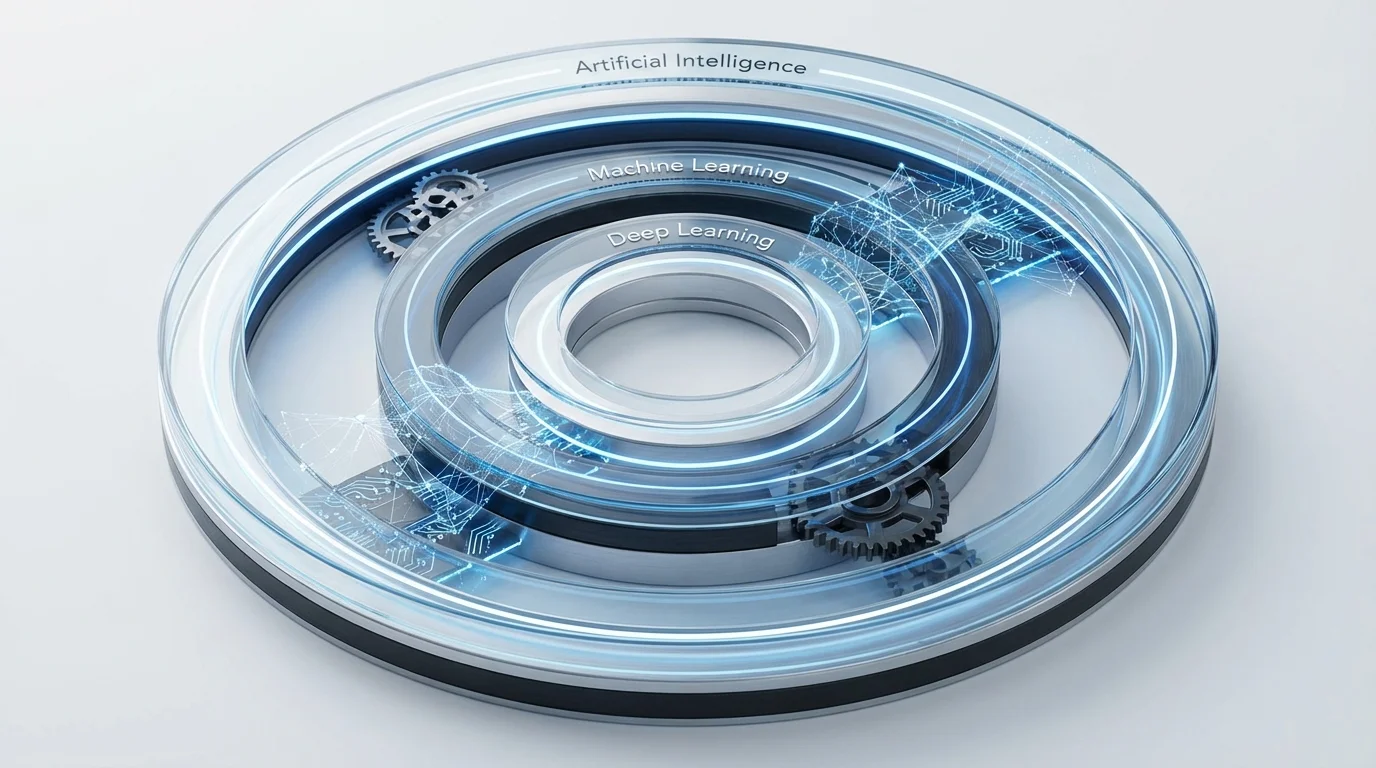
Machine learning and deep learning are two of the most frequently used terms in technology today, and they are often used interchangeably — which is a problem, because they are not the same thing. Deep learning is a subset of machine learning, which is itself a subset of artificial intelligence. Understanding the distinction is not just academic — it determines which approach is right for a given problem, how much data and computing power you need, and what kind of results you can expect.
If you are a developer choosing a technical approach, a business leader evaluating AI solutions, or a curious person trying to understand the technology reshaping the world, this guide will give you a clear, thorough understanding of both machine learning and deep learning — how they work, how they differ, and when each one is the right tool for the job.
The Big Picture: How ML and DL Relate to AI
Think of these three terms as nested circles. Artificial intelligence is the broadest concept — any technique that enables machines to mimic human intelligence. Machine learning is a subset of AI — specifically, algorithms that learn from data without being explicitly programmed for every scenario. Deep learning is a subset of machine learning — algorithms that use layered neural networks to learn from large amounts of data.
Every deep learning system is a machine learning system, but not every machine learning system uses deep learning. A spam filter that uses a decision tree to classify emails is machine learning but not deep learning. A system that analyzes chest X-rays to detect pneumonia using a convolutional neural network is deep learning — and therefore also machine learning.
This hierarchy matters because it frames the key question: when do you need the complexity and power of deep learning, and when is simpler machine learning sufficient or even superior?
Machine Learning: Learning from Data
What Machine Learning Is
Machine learning is a set of algorithms that enable computers to learn patterns from data and make predictions or decisions without being explicitly programmed for each specific case. Instead of writing rules like "if the email contains these words, it is spam," you feed the algorithm thousands of examples of spam and non-spam emails, and it learns to distinguish between them on its own.
The key insight behind machine learning is that for many problems, it is easier to show a computer examples of correct behavior than to write explicit rules that cover every possible scenario. Language has too many nuances for hand-written rules. Visual patterns are too complex to describe programmatically. Human behavior is too varied to predict with simple if-then logic.
The Three Types of Machine Learning
Machine learning is divided into three main paradigms, each suited to different types of problems.
Supervised Learning is the most common type. The algorithm is trained on labeled data — input-output pairs where the correct answer is known. For example, you show the algorithm thousands of house listings with features (square footage, location, number of bedrooms) and the actual sale price. The algorithm learns the relationship between features and price, then predicts prices for new listings.
Supervised learning excels at classification (is this email spam or not?) and regression (what will this house sell for?). Common algorithms include linear regression, logistic regression, decision trees, random forests, support vector machines, and gradient boosting methods like XGBoost.
Unsupervised Learning works with unlabeled data — the algorithm finds patterns and structure without being told what to look for. Clustering algorithms group similar data points together (customer segmentation, anomaly detection). Dimensionality reduction techniques simplify complex data while preserving important relationships.
Unsupervised learning is valuable when you do not know what patterns exist in your data or when labeling data is too expensive or impractical. Common algorithms include k-means clustering, hierarchical clustering, principal component analysis (PCA), and association rules.
Reinforcement Learning trains agents to make decisions by interacting with an environment and receiving rewards or penalties. The algorithm is not shown correct answers — it discovers optimal strategies through trial and error. Reinforcement learning produced AlphaGo, the first AI to defeat a world champion at Go, and powers robotic control systems, game-playing AI, and recommendation algorithms.
Reinforcement learning is the most complex paradigm and requires carefully designed reward functions. It excels at sequential decision-making problems where the long-term outcome matters more than any individual action.
How Machine Learning Models Work
Traditional machine learning models follow a consistent workflow:
Feature engineering. Humans identify and extract the relevant features (variables) from raw data. For a house price model, features might include square footage, zip code, year built, and number of bathrooms. Feature engineering is often the most important and time-consuming step in traditional machine learning — the quality of features largely determines the quality of predictions.
Model training. The algorithm processes the training data and adjusts its internal parameters to minimize prediction errors. A decision tree learns which features best separate the data. A linear regression finds the best-fit line. A random forest builds hundreds of decision trees and averages their predictions.
Evaluation. The model is tested on data it has not seen before to measure its accuracy, precision, recall, and other metrics. If performance is insufficient, engineers adjust features, try different algorithms, or tune hyperparameters.
Deployment. The trained model is integrated into an application where it processes new data and generates predictions in real time.
Strengths of Traditional Machine Learning
Traditional ML has important advantages that keep it dominant for many applications:
Interpretability. You can often understand why a traditional ML model made a specific prediction. A decision tree shows exactly which features and thresholds led to a decision. A linear regression assigns clear weights to each feature. This interpretability is critical in regulated industries like healthcare, finance, and insurance where decisions must be explainable.
Data efficiency. Traditional ML algorithms can learn effectively from hundreds or thousands of examples. You do not need millions of data points to build a useful model. For many real-world problems, labeled data is scarce and expensive to create.
Computational efficiency. Traditional ML models train in minutes or hours on standard hardware. They do not require expensive GPU clusters or weeks of training time. This makes them practical for small teams with limited budgets.
Reliability. Well-designed traditional ML systems are stable and predictable. They do not hallucinate or generate unexpected outputs. For many business applications, reliable and explainable predictions are more valuable than marginally higher accuracy.
Deep Learning: Neural Networks at Scale
What Deep Learning Is
Deep learning is machine learning using artificial neural networks with multiple layers — "deep" referring to the number of layers in the network. These networks learn hierarchical representations of data, automatically discovering the features that matter rather than relying on human-engineered features.
A deep neural network for image recognition might learn to detect edges in its first layer, simple shapes in the second, complex shapes in the third, and entire objects in deeper layers. The network builds increasingly abstract and sophisticated representations as data flows through the layers.
This automatic feature learning is deep learning's key advantage. Instead of requiring human experts to identify and extract relevant features from raw data, deep learning models learn optimal features directly from the data itself. For complex, high-dimensional data like images, audio, and natural language, this automated approach dramatically outperforms manual feature engineering.
How Neural Networks Work
A neural network is composed of layers of interconnected nodes (neurons), loosely inspired by biological neurons in the human brain.
Input layer. Raw data enters the network — pixels from an image, words from a sentence, or numerical features from a dataset.
Hidden layers. Data passes through one or more intermediate layers where transformations occur. Each neuron receives inputs from the previous layer, applies a mathematical function (called an activation function), and passes the result to the next layer. The connections between neurons have weights that are adjusted during training.
Output layer. The final layer produces the network's prediction — a classification label, a probability, a generated token, or a numerical value.
Training (backpropagation). When the network makes a prediction error, the error signal propagates backward through the network, and the connection weights are adjusted to reduce future errors. This process, repeated millions or billions of times across the training data, gradually improves the network's accuracy.
Types of Deep Learning Architectures
Different neural network architectures are optimized for different types of data and tasks.
Convolutional Neural Networks (CNNs) are designed for grid-structured data like images. Convolutional layers apply filters that detect local patterns — edges, textures, shapes — and pooling layers progressively reduce spatial dimensions. CNNs dominate image classification, object detection, medical imaging, and autonomous driving.
Recurrent Neural Networks (RNNs) and LSTMs were designed for sequential data like text and time series. They maintain a memory of previous inputs, allowing them to process sequences of variable length. While largely superseded by transformers for language tasks, RNNs remain useful for some time-series applications.
Transformers use attention mechanisms to process all elements of an input simultaneously, capturing long-range dependencies that RNNs struggle with. Transformers are the foundation of all modern large language models and are increasingly applied to vision, audio, and other domains.
Generative Adversarial Networks (GANs) consist of two competing networks — a generator that creates data and a discriminator that tries to distinguish generated data from real data. This adversarial training produces remarkably realistic generated content.
Strengths of Deep Learning
Superior performance on complex data. For images, audio, video, and natural language, deep learning dramatically outperforms traditional ML. The ability to learn features automatically from raw data eliminates the bottleneck of manual feature engineering and often discovers patterns that human engineers would never identify.
Scalability. Deep learning performance generally improves with more data and more computing power. This scaling behavior — more data equals better results — is a fundamental advantage for organizations with access to large datasets.
Transfer learning. Models trained on one task can be fine-tuned for related tasks, dramatically reducing the data and compute needed for new applications. A vision model trained on millions of generic images can be fine-tuned with just hundreds of domain-specific medical images to detect specific conditions.
End-to-end learning. Deep learning systems can learn to map raw inputs directly to desired outputs without intermediate steps. An image captioning system can learn to go directly from pixels to natural language descriptions without separate object detection, scene analysis, and sentence generation stages.
Machine Learning vs Deep Learning: The Key Differences
Data Requirements
Traditional ML works well with hundreds to thousands of data points. Deep learning typically requires tens of thousands to millions of examples to train effectively. If your dataset is small, traditional ML is usually the better choice. If you have massive amounts of data, deep learning can exploit it more effectively.
Feature Engineering
Traditional ML requires humans to identify and engineer the right features — a process that demands domain expertise and significant effort. Deep learning learns features automatically from raw data. For problems where the right features are obvious (tabular data with clear columns), manual engineering works well. For problems where features are not obvious (what features of an image indicate "cat"?), automatic learning wins.
Computational Cost
Training a traditional ML model requires modest computing resources — a laptop can handle many tasks. Training a deep learning model, especially a large one, requires powerful GPUs or TPUs, often for days or weeks, at costs that can reach millions of dollars for the largest models. This cost difference influences which approach is practical for a given organization and problem.
Interpretability
Traditional ML models, particularly decision trees and linear models, provide clear explanations for their predictions. Deep learning models are largely black boxes — they achieve excellent results but offer limited insight into why they made a specific prediction. In contexts where explainability is legally or ethically required, this difference can be decisive.
Performance Ceiling
For structured, tabular data (spreadsheets, databases, financial records), traditional ML methods — particularly gradient boosting algorithms like XGBoost and LightGBM — remain competitive with or superior to deep learning. Multiple Kaggle competitions have demonstrated that gradient boosting outperforms deep learning on tabular data more often than not.
For unstructured data (images, text, audio, video), deep learning is clearly superior. The performance gap is so large that traditional ML is rarely even considered for these tasks anymore.
When to Use Machine Learning vs Deep Learning
Choose Traditional Machine Learning When
- Your dataset is small (under 10,000 examples)
- Your data is tabular and structured
- You need interpretable, explainable predictions
- You have limited computing resources
- Speed of training and deployment matters
- Domain experts can identify the relevant features
- You need reliable, stable predictions in production
Real-world examples: Credit scoring, fraud detection, customer churn prediction, inventory demand forecasting, medical diagnosis from structured patient data, insurance risk assessment.
Choose Deep Learning When
- You have large amounts of data (100,000+ examples)
- Your data is unstructured (images, text, audio, video)
- Maximum accuracy is more important than interpretability
- You have access to GPUs or cloud computing
- The problem involves pattern recognition in complex data
- Feature engineering would be impractical or impossible
- You can leverage pre-trained models through transfer learning
Real-world examples: Image classification and object detection, natural language processing and generation, speech recognition, autonomous driving, medical imaging analysis, recommendation systems at scale.
The Hybrid Approach
In practice, many production AI systems combine both approaches. A recommendation engine might use deep learning to extract features from product images and descriptions but gradient boosting to make the final recommendation based on user behavior data. A fraud detection system might use a neural network to analyze transaction patterns but a rules-based system for known fraud signatures.
The best practitioners choose the simplest approach that achieves the required performance. Starting with traditional ML and moving to deep learning only when the problem demands it is sound engineering practice.
The Future: Convergence and New Frontiers
The boundary between machine learning and deep learning is becoming increasingly blurred. Several trends are reshaping the landscape.
Foundation models — large models pre-trained on vast datasets — are enabling deep learning capabilities with minimal data. Fine-tuning a pre-trained model requires far fewer examples than training from scratch, reducing the data advantage that traditional ML held for small datasets.
AutoML and neural architecture search automate much of the expertise previously required for deep learning. Tools like Google's AutoML, Auto-sklearn, and FLAML can automatically select and tune models, reducing the technical barrier to entry.
Efficient architectures are reducing the computational cost of deep learning. Techniques like knowledge distillation, pruning, and quantization make it possible to run sophisticated neural networks on mobile phones and edge devices.
Tabular deep learning is an active research area. While gradient boosting still leads on most tabular benchmarks, models like TabNet, FT-Transformer, and various hybrid approaches are narrowing the gap. The future may see deep learning become competitive across all data types.
Neuro-symbolic AI combines neural networks with symbolic reasoning — the rule-based approach that preceded machine learning. These hybrid systems aim to combine deep learning's pattern recognition with classical AI's logical reasoning and interpretability.
Conclusion
Machine learning and deep learning are not competing approaches — they are complementary tools in the AI toolkit. Machine learning provides reliable, interpretable, and efficient solutions for structured data problems. Deep learning delivers breakthrough performance on complex, unstructured data where manual feature engineering is impractical.
The right choice depends on your specific problem: how much data you have, what type of data it is, whether you need explainability, what computing resources are available, and what level of accuracy is required.
Understanding both approaches — their strengths, limitations, and appropriate use cases — is essential knowledge for anyone working with AI in 2026. The field is moving fast, but the fundamental principles that distinguish machine learning from deep learning remain relevant and will continue to guide practical AI decisions for years to come.
The most effective AI practitioners are not loyal to one approach over another. They understand the full spectrum of techniques, from simple linear regression to billion-parameter transformers, and they choose the right tool for each problem. That pragmatic, problem-first mindset is worth more than any individual algorithm.